A factory cannot choose the right solar plant from an annual electricity bill or a panel count alone. You will need to match interval demand, roof conditions, grid-connection limits, operating goals and supplier guarantees before approving a design, especially when comparing a 50 kW proposal.
Key takeaways
- Use 12 months of 15-minute or 30-minute demand data to size the plant.
- Define kW for power output and kWh for battery storage or energy use.
- Check roof structure, transformer capacity and sanctioned load before ordering.
- Require warranties, single-line diagrams, test reports and commissioning records.
Size the Plant from Factory Demand, Not Roof Space Alone
Start with 12 months of 15-minute or 30-minute electricity data, not roof area. The right plant offsets daytime factory demand without creating unwanted exports or exceeding the sanctioned connection.
1. Collect monthly bills, sanctioned load, contract demand, transformer capacity and the applicable MSEDCL interconnection category. Obtain interval data showing weekday, weekend and shift-wise demand, then identify the factory’s minimum and average daytime load.
2. Set a preliminary AC inverter capacity below the daytime demand that the plant can reliably consume. Check the export limit before increasing it; an oversized array can curtail output, export electricity at poor value or require an approval the connection cannot support.
3. Record shadow-free roof or ground area, roof orientation, usable mounting zones, access paths and obstructions. Do not let area dictate capacity: confirm dead load, wind uplift, seismic effects, roof age, drainage, corrosion and waterproofed attachment points through a structural survey.
4. Define the proposal precisely. “50 kW” must state whether it means 50 kWp of modules or 50 kW AC inverter output, along with the DC/AC ratio, clipping assumptions and guaranteed export capacity. If considering batteries, request month-by-month models for self-consumption, peak shaving, backup and no-battery operation using the actual tariff and interval load.
Before requesting quotations, ask for an AC capacity recommendation tied to these figures and written confirmation from MSEDCL on export eligibility, meter configuration and synchronisation. This method applies whether your search began with solar for company in nashik or a larger industrial project.
Choose Grid-Tied, Hybrid or Off-Grid—and Define Every kW and kWh
A grid-tied system fits a factory with reliable utility supply and substantial daytime consumption; it is usually the simplest, lowest-cost architecture. Choose hybrid when batteries must cover selected loads during outages or shift solar energy into expensive tariff periods. Choose off-grid only when utility power is unavailable or abandoning the connection is economically justified.
| Option | What it means | When it applies |
|---|---|---|
| Grid-tied | Solar inverter synchronises with the utility; anti-islanding stops export during a grid failure | Daytime load offset with dependable grid supply |
| Hybrid | Grid-tied solar plus battery and backup controls | Peak shaving, time-of-day shifting or critical-load backup |
| Off-grid | Solar, batteries and backup generation operate without the utility | Remote sites or deliberately independent supply |
Do not approve “50 kW” until the quotation identifies 50 kWp of module DC capacity or 50 kW AC inverter capacity. A 50 kWp array on a smaller inverter can improve utilisation but clips output in strong sun; require the DC/AC ratio, clipping assumptions and guaranteed AC export capacity.
kW measures instantaneous power: inverter size, sanctioned load and contract demand. kWp labels the modules’ rated DC power. kWh measures energy: battery storage, daily consumption and generation. Size from 12 months of 15-minute or 30-minute demand data, not annual kWh alone.
Confirm sanctioned load, contract demand, transformer capacity and the MSEDCL interconnection category before fixing capacity. A battery’s savings require a tariff-based dispatch model covering self-consumption, peak shaving, backup and no-battery cases.
Evaluate a 50 kW Solar System in Nashik with a Worked Design Example
A credible 50 kW solar system in Nashik must state whether “50 kW” means 50 kWp of modules or 50 kW AC inverter capacity. For example, a factory proposal could use 50 kWp DC with a 40 kW AC inverter, disclose the 1.25 DC/AC ratio, estimate clipping, and guarantee export capacity at the agreed meter.
Worked example inputs should include:
- Factory consumption: 18,000 kWh per month, with 70% used between 9 a.m. and 5 p.m.; daytime demand remains above 25 kW.
- Roof: 450–550 square metres of shadow-free, structurally approved area, including access and maintenance paths.
- Production assumption: 5.0 kWh per kWp per day of solar resource, less 18% for temperature, soiling, wiring and inverter losses.
- Expected output: about 205 kWh per day, or 74,800 kWh per year, subject to shading and availability.
The commercial offer should separate modules, inverter, mounting, DC and AC cabling, protection, civil work, monitoring, taxes, utility fees and commissioning. Require a structural engineer’s calculation covering wind uplift, dead load, drainage, corrosion and waterproofing.
Require the single-line diagram to show the point of common coupling, AC isolator, protection, earthing, lightning protection, meter, transformer connection and export control. Ask for written MSEDCL confirmation of synchronisation and metering, plus a battery dispatch model if storage is proposed.
Check the Roof, Transformer and Interconnection Before Ordering
Do not order modules until a structural engineer and MSEDCL interconnection review confirm that the roof, transformer and protection scheme can carry the plant safely. A cheaper quotation becomes expensive if export is blocked, approval stalls or the roof leaks.
1. Commission a documented roof-condition survey. The engineer must check roof age, corrosion, purlins or RCC slab capacity, dead load, wind uplift, seismic effects, drainage and maintenance access. Require calculations for the complete mounting system, including attachment-point waterproofing; module weight alone proves nothing.
2. Confirm the electrical boundary before fixing capacity. Match at least 12 months of 15-minute or 30-minute demand data with sanctioned load, contract demand, transformer rating and the MSEDCL LT or HT category. Require a single-line diagram showing the point of common coupling, AC isolator, cable sizes, earthing, lightning protection, metering and export-control equipment.
3. Make anti-islanding testable. The tender must state inverter voltage and frequency trip settings, reconnection delay, test method and who obtains relay-setting approval. “Grid compliant” without test records does not prove that a failed grid cannot be energised from the factory.
4. Reject production estimates without a loss table. Require a site simulation using roof azimuth and tilt, horizon shading, temperature, soiling, mismatch, clipping, availability and degradation, with separate P50 and P90 results.
Ask for IEC 61215 and IEC 61730 evidence plus applicable BIS requirements; IEC 61215 alone does not prove fire performance, warranty validity or roof suitability.
Compare Suppliers by Documents, Guarantees and Acceptance Tests
Choose an industrial solar power system supplier by matching its paperwork to the risks at your factory, not by comparing the headline price alone. Reject any quotation that combines equipment and services into one unexplained amount.
| Supplier evidence | What to demand | Why it matters |
|---|---|---|
| Commercial offer | Separate module, inverter, mounting, cabling, protection, civil work, utility fees, monitoring, insurance, commissioning and taxes | Exclusions otherwise appear after ordering |
| Technical schedule | Module and inverter model numbers, DC/AC ratio, clipping assumption, guaranteed AC export capacity and single-line diagram | “50 kW” could mean 50 kWp of modules or 50 kW of inverter output |
| Guarantee schedule | Output measured at inverter AC terminals, plant meter or utility meter; degradation, response time and exclusions | Internal losses and meter tolerances change the result |
| Acceptance test | Insulation resistance, earthing, polarity, inverter settings, protective-trip tests, meter readings and commissioning records | A system can energise while remaining unsafe or underperforming |
Ask for a structural engineer’s calculation and roof-condition survey covering dead load, wind uplift, seismic effects, corrosion, drainage and waterproofed attachment points. Require a cleaning schedule stating trigger or frequency, water quality, labour, water cost and access responsibility; “free cleaning” alone proves nothing.
For Nashik, require written MSEDCL confirmation of export eligibility, application capacity, meter configuration, synchronisation approval and any network study. A solar company for factories in Nashik should attach these documents to the contract, not promise them verbally.
Photon Energies belongs on your comparison sheet only after it supplies the same evidence as competing bidders. Then run the documented tests before final payment.
Related products
 | Solar Power System Capacity 43 KW Type Of Plant Grid Tie Usage/Application Industrial Warranty Of Solar Panels 25 Years** Established as a Partnership firm in the year... View product → |
 | Solar Power System ₹1575000 Usage/Application Commercial Capacity 45 KW Type Of Plant Grid Tie Other Components Mounting Structure Warranty Of Solar Panels 30Years**, 10 - 24... View product → |
Frequently asked questions
How do you size an industrial solar system for a factory?
Analyse 12 months of 15-minute or 30-minute electricity data, then match solar output to daytime demand, sanctioned load and acceptable grid exports rather than roof area alone.
Should a factory choose a grid-tied, hybrid or off-grid solar system?
Choose grid-tied for daytime bill reduction with a reliable grid, hybrid when batteries must support selected loads during outages, and off-grid only when the site cannot rely on a grid connection.
What should you check before buying a 50 kW solar system in Nashik?
Confirm the factory's load profile, roof condition, shadow-free area, transformer and sanctioned connection capacity, interconnection requirements, and the supplier's system design.
What documents and tests should an industrial solar supplier provide?
Request the bill of quantities, datasheets, single-line diagram, warranty terms, protection settings, test reports, commissioning records and an acceptance test linked to measured system output.
Related products
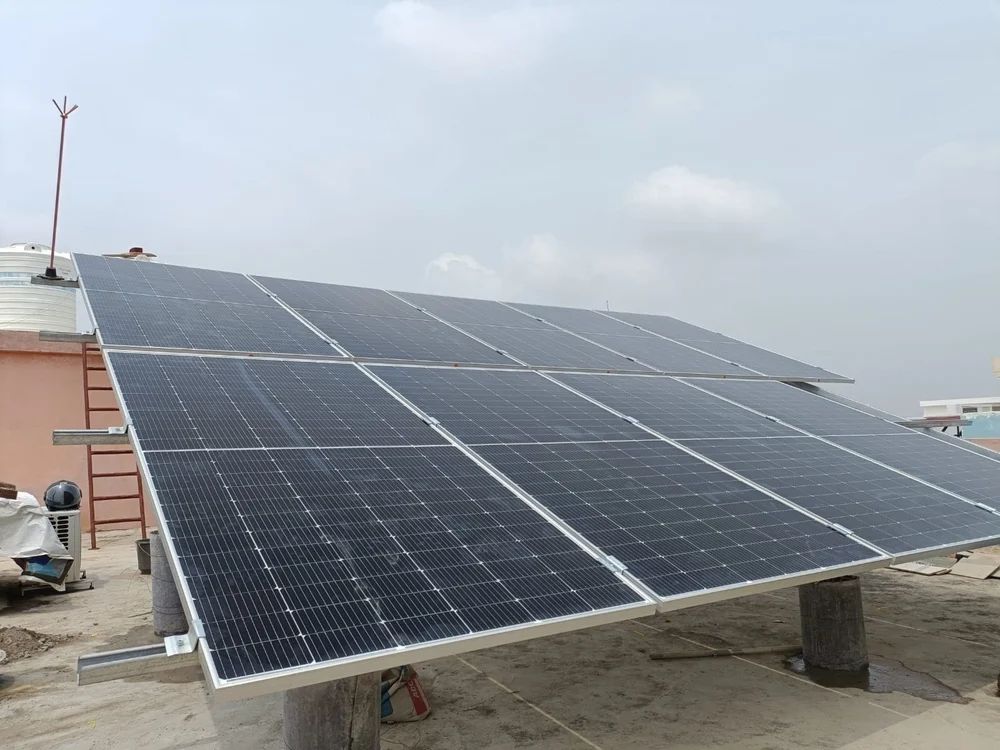 | Solar Power System Capacity 4 kW Warranty of Solar Panel 10 - 24 years Usage Commercial Type Rooftop Country of Origin Made in India Established as a Partnership firm... View product → |
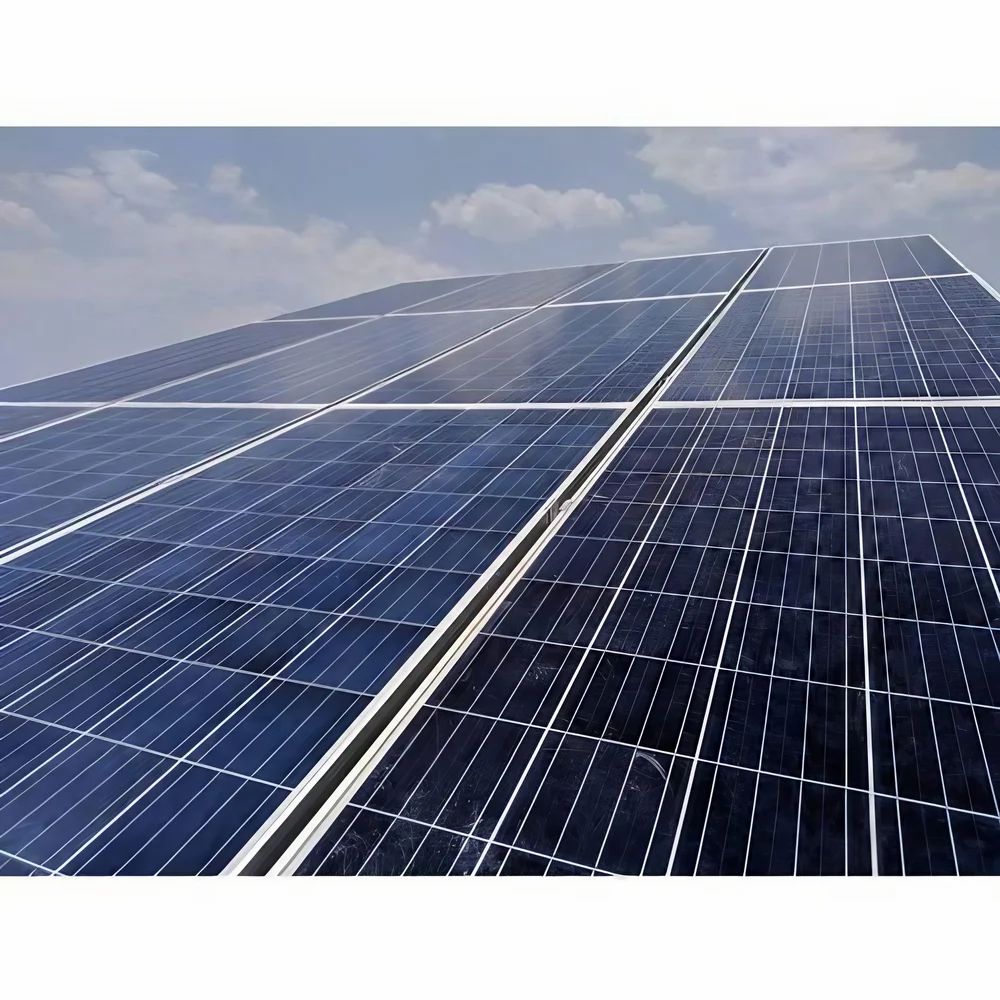 | Solar Power System Capacity 10 KW Type Of Plant Grid Tie Warranty Of Solar Panels 2 - 5 Years*, 25 Years** Country of Origin Made in India Established as a Partnership... View product → |
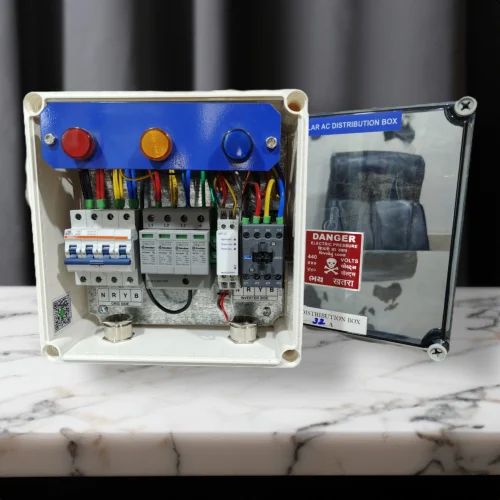 | Solar System Capacity 25 kW Usage Solar Application Home Country of Origin Made in India 3Ph ACDB With NVR (No Volt Relay) 4pole 3phase MCB 32A - C&S Make 3Phase... View product → |
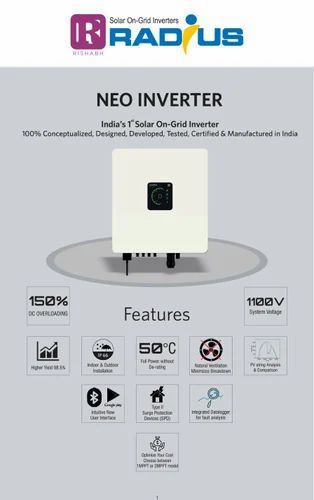 | Solar Power System Rishabh Radius Solar On Grid String Inverters Battery Type Charged Lithium ion and Lead Acid Part Number Neuron Output Voltage As per battery Charge Current as per battery capacity Country of... View product → |
Keywords