Debunking Solar: The Technical Truths Behind Common PV Myths
By The Engineering Team at Photon Energies December 19, 2025
As India accelerates towards its renewable energy targets, solar PV (Photovoltaic) technology has moved from a "niche experiment" to a mainstream power source. However, despite the visible boom on rooftops across Maharashtra and beyond, we still encounter hesitation driven by outdated information.
At Photon Energies, we believe that the best decisions are made with data, not anecdotes. Today, we are peeling back the marketing layers to look at the physics and engineering realities behind the four most common myths in the solar industry.
Myth #1: "Solar Panels Are Useless on Cloudy Days"
The Engineering Reality: This is perhaps the most persistent myth. It stems from a misunderstanding of how photovoltaic cells utilize light. Solar panels do not require heat to generate electricity; they require photons (light energy).
While it is true that panels perform at peak efficiency under Direct Normal Irradiance (DNI)—essentially direct sunlight—they are also designed to capture Diffuse Horizontal Irradiance (DHI). This is sunlight that has been scattered by molecules and particles in the atmosphere (clouds).
The Data: On a heavily overcast day, a high-quality Monocrystalline system (like our high-efficiency modules) can still generate 30% to 50% of its rated capacity.
The Physics: Modern cells, especially those with PERC (Passivated Emitter and Rear Contact) technology, have excellent spectral response even in the blue-light wavelengths dominant on cloudy days.
The Photon Energies Advantage: We utilize advanced Monocrystalline technology that excels in low-light environments, ensuring your system wakes up earlier in the morning and sleeps later in the evening, maximizing generation hours regardless of the weather.
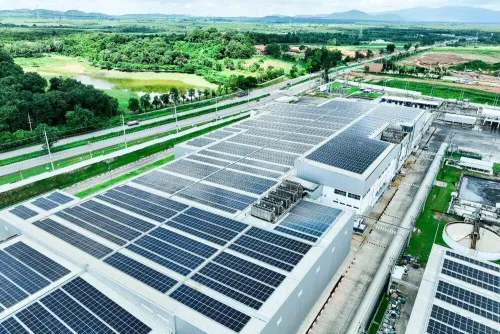
A rooftop solar installation by Photon Energies functioning efficiently under a partly cloudy sky.
Myth #2: "Maintenance is a Headache and Expensive"
The Engineering Reality: Solar PV systems are arguably the most passive form of power generation in existence. Unlike a diesel generator or a car engine, a solar PV system has zero moving parts.
Wear and Tear: Without moving parts, there is no friction, no lubrication required, and extremely low mechanical wear.
Cleaning: In most of India, the "self-cleaning" effect of rainfall is sufficient for 4-5 months of the year. During dry seasons, a simple water wash every few weeks is all that is required to remove dust (soiling losses).
Reliability: The standard lifespan of a Tier-1 solar module is 25+ years. The primary active component is the Inverter, which typically runs for 10-12 years before needing attention.
The Photon Energies Advantage: We don't just sell products; we engineer solutions. Our Solar PV Systems come with robust mounting structures designed to withstand high wind speeds, and we offer comprehensive Annual Maintenance Contracts (AMCs) so you never have to worry about the technical details.
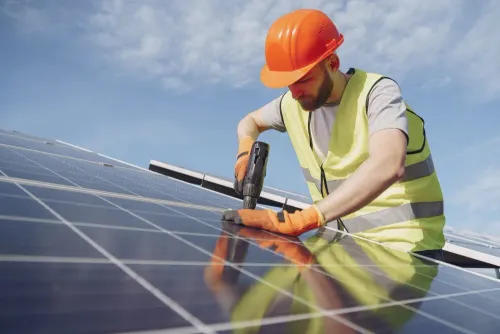
A professional Photon Energies technician performing a routine check on a solar inverter.
Myth #3: "The ROI Takes a Lifetime (It's Too Expensive)"
The Engineering Reality: This myth is a hangover from 2010. In 2025, the economics of solar have fundamentally flipped. We look at a metric called LCOE (Levelized Cost of Energy).
Currently, the cost of generating one unit (kWh) of electricity from a rooftop solar system over its lifetime is approximately ₹2.50 to ₹3.50. Compare this to the commercial grid tariffs in Maharashtra, which can range from ₹8.00 to ₹14.00+ per unit.
Payback Period: For most commercial and industrial clients, the "Break-Even Point" is now between 3 to 4 years.
Profit Period: Since the system lasts 25 years, you effectively get roughly 20 years of free electricity after the payback period.
The Photon Energies Advantage: We design systems to optimize this ROI. By rightsizing your inverter and analyzing your shadow profile, we ensure you aren't paying for capacity you can't use, keeping your initial CAPEX low and your savings high.
Myth #4: "Solar Panels Are a Fire Hazard"
The Engineering Reality: Safety is our top priority. Statistically, you are more likely to have a fire caused by a toaster than a solar panel. Global studies indicate that less than 0.02% of solar installations ever experience a thermal event.
However, when issues do occur, they are almost never the fault of the panel itself, but rather poor installation practices, such as:
Using undersized DC cables that overheat.
Improper crimping of MC4 connectors (creating electrical arcs).
Lack of proper Earthing/Grounding protection.
The Verdict
Solar technology is not magic; it is mature, reliable engineering. The myths of the past have been solved by the innovation of the present.
Are you ready to make a data-driven decision for your home or business?
Contact Photon Energies today.
Er. Kamran Shaikh
Keywords